×


29 Oct 2024
The Patanjala Yoga Sutra is a foundational text of classical yoga philosophy. This guide explains Patanjali Yoga Sutras 1.1–1.12 with Sanskrit verses, English meanings, the five Chitta Vrittis, Abhyasa, Vairagya, and practical study guidance for YCB Level 1 Yoga Protocol Instructor students.
The first twelve Yoga Sutras of Patanjali introduce some of the most important concepts in classical yoga philosophy.
They explain the nature of yoga, the relationship between awareness and mental activity, the five categories of Chitta Vritti, and the importance of Abhyasa and Vairagya.
For students preparing for YCB Level 1 Yoga Protocol Instructor certification, these sutras form an important part of the prescribed theoretical syllabus.
However, memorizing Sanskrit verses without understanding their philosophical meaning is insufficient for developing a sound foundation in yoga education.
This guide presents the first twelve sutras with Sanskrit, transliteration, accessible explanations and examples relevant to yoga teaching.
The Yoga Sutras are traditionally attributed to Patanjali and organized into four chapters called Padas.
The first chapter, Samadhi Pada, examines the nature of yoga, mental activity, concentration and states of meditative absorption.
The number of sutras in the complete text is sometimes given as 195 or 196, depending on the textual tradition and edition.
The opening twelve sutras establish three connected ideas: the aim of yoga, the different forms of mental activity and the means of regulating those activities.
The interpretations below are introductory explanations. Classical commentators sometimes differ in their treatment of particular Sanskrit terms.
For a more detailed philosophical perspective, consult the Internet Encyclopedia of Philosophy’s discussion of Patanjali’s Yoga Sutras. Internet Encyclopedia of Philosophy
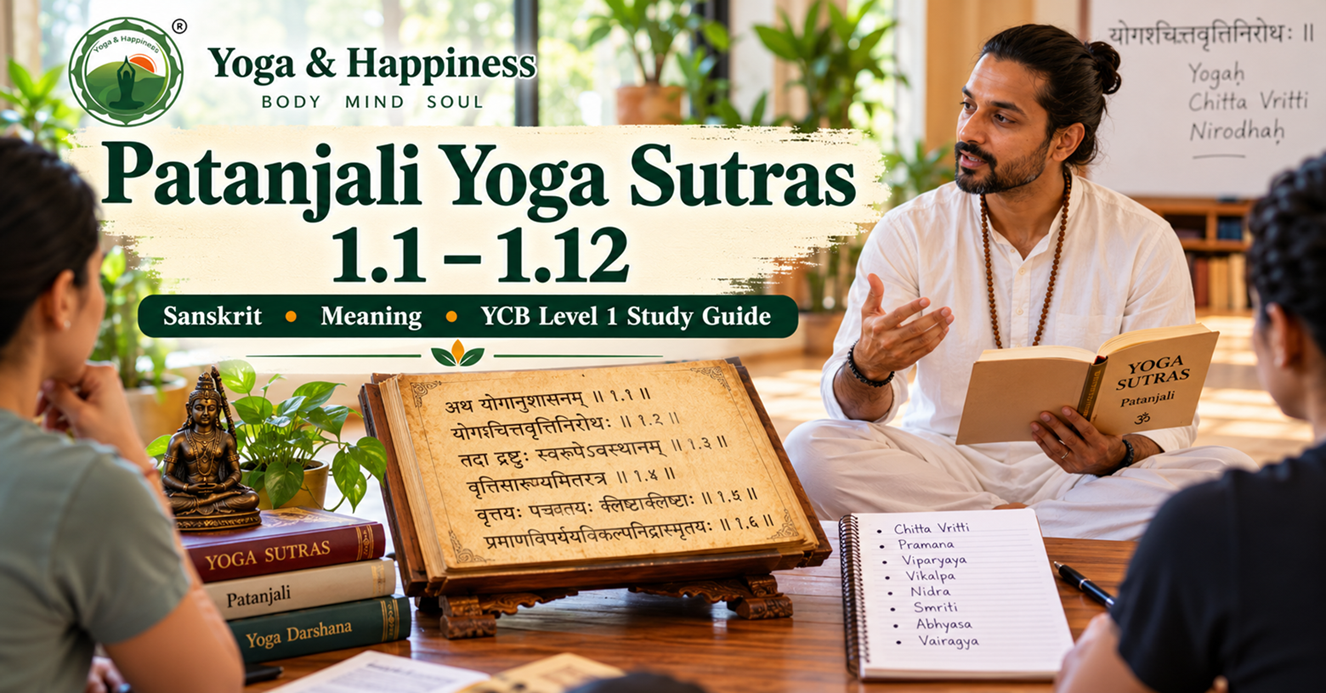
Sanskrit: अथ योगानुशासनम्॥
Transliteration: Atha yogānuśāsanam.
Meaning: Now begins the systematic instruction in yoga.
The opening word Atha introduces the subject of yoga as a disciplined field of study and practice.
Anushasanam suggests systematic instruction within an established teaching tradition.
The sutra does not simply announce a collection of physical exercises.
It introduces yoga as a structured discipline requiring understanding, practice and commitment.
Teaching application: Begin a yoga philosophy course by explaining its objectives, methods and expectations. Students should understand why practices are taught rather than merely imitate techniques.
Sanskrit: योगश्चित्तवृत्तिनिरोधः॥
Transliteration: Yogaś citta-vṛtti-nirodhaḥ.
Meaning: Yoga is the stilling or restraint of the fluctuations of Chitta.
This is the central definition of yoga in Patanjali’s system.
Chitta refers broadly to the mind or mental faculty, while Vrittis are its activities or modifications.
Nirodha is commonly interpreted as restraint, stilling or cessation within the context of classical yoga practice.
It should not be reduced to the instruction to forcibly suppress every thought.
Patanjali is describing a philosophical and contemplative objective, not providing a modern clinical definition of mental health.
Teaching application: Explain the distinction between observing mental activity and struggling against thoughts. Students should understand that occasional distraction during meditation is not evidence of personal failure.
Sanskrit: तदा द्रष्टुः स्वरूपेऽवस्थानम्॥
Transliteration: Tadā draṣṭuḥ svarūpe ‘vasthānam.
Meaning: Then the Seer abides in its own nature.
The term Drashta refers to the Seer or witnessing consciousness.
Within classical Yoga philosophy, the Seer is distinguished from the changing activities of Chitta.
When those activities are restrained, the Seer is understood to remain established in its own nature.
This is a metaphysical teaching within the Yoga tradition. It should not be presented as a scientifically demonstrated account of consciousness.
Teaching application: Introduce the difference between awareness and the changing contents of experience as a philosophical concept.
Sanskrit: वृत्तिसारूप्यमितरत्र॥
Transliteration: Vṛtti-sārūpyam itaratra.
Meaning: At other times, the Seer appears identified with the modifications of the mind.
Patanjali contrasts the state described in Sutra 1.3 with ordinary experience.
Thoughts, emotions, memories and perceptions constantly change.
Within this philosophical framework, identification with these changing experiences obscures recognition of the Seer’s distinct nature.
For example, someone experiencing anger may identify entirely with that emotional state.
The sutra invites reflection on the distinction between a changing experience and the philosophical idea of the witnessing Seer.
Sanskrit: वृत्तयः पञ्चतय्यः क्लिष्टाक्लिष्टाः॥
Transliteration: Vṛttayaḥ pañcatayyaḥ kliṣṭākliṣṭāḥ.
Meaning: Mental modifications are of five kinds and may be afflicted or unafflicted.
This sutra introduces two important classifications.
Klishta refers to mental activity associated with affliction or obstacles to liberation.
Aklishta refers to activity that is not similarly afflicted and may support discriminative understanding.
An important teaching point is that Patanjali does not describe every thought as inherently harmful.
The nature and consequences of mental activity matter.
Sanskrit: प्रमाणविपर्ययविकल्पनिद्रास्मृतयः॥
Transliteration: Pramāṇa-viparyaya-vikalpa-nidrā-smṛtayaḥ.
Meaning: The five modifications are valid knowledge, error, conceptual construction, sleep and memory.
Patanjali identifies five categories of mental activity.
| Sanskrit term | Introductory meaning |
|---|---|
| Pramana | Valid knowledge |
| Viparyaya | Erroneous knowledge |
| Vikalpa | Verbal or conceptual construction |
| Nidra | Sleep |
| Smriti | Memory |
These categories are further explained in Sutras 1.7–1.11.
For YCB students, learning the sequence is important, but the ability to distinguish the categories is more valuable than memorization alone.
Sanskrit: प्रत्यक्षानुमानागमाः प्रमाणानि॥
Transliteration: Pratyakṣa-anumāna-āgamāḥ pramāṇāni.
Meaning: Valid knowledge arises through perception, inference and authoritative testimony.
Patanjali identifies three accepted sources of knowledge within the Yoga philosophical system.
Pratyaksha refers to direct perception.
Anumana refers to inference.
Agama refers to reliable or authoritative testimony.
For example, seeing an object is an instance of perception, while drawing a conclusion from observed evidence involves inference.
In traditional philosophical study, authoritative testimony has a specific epistemological role.
These categories should not be presented as identical to contemporary scientific research methods, although comparing different approaches to knowledge can be educationally useful.
Sanskrit: विपर्ययो मिथ्याज्ञानमतद्रूपप्रतिष्ठम्॥
Transliteration: Viparyayo mithyā-jñānam atad-rūpa-pratiṣṭham.
Meaning: Error is knowledge that does not correspond to the actual nature of its object.
Viparyaya describes mistaken cognition.
A traditional example is mistaking a rope for a snake in poor lighting.
The initial perception appears convincing, but further observation reveals the mistake.
Teaching application: Encourage students to examine assumptions and correct misunderstandings through careful study.
In professional yoga education, this principle also supports avoiding unsupported claims about anatomy, physiology or health outcomes.
Sanskrit: शब्दज्ञानानुपाती वस्तुशून्यो विकल्पः॥
Transliteration: Śabda-jñāna-anupātī vastu-śūnyo vikalpaḥ.
Meaning: Vikalpa is a conceptual construction arising from words without a corresponding actual object.
Vikalpa concerns the relationship between language and mental representation.
Words can generate meaningful ideas even when no corresponding object exists.
This does not mean that every use of imagination or metaphor is harmful.
The philosophical distinction concerns how concepts are formed and understood.
Teaching application: Ask students to distinguish direct observation from assumptions generated by descriptions, expectations or language.
Sanskrit: अभावप्रत्ययालम्बना वृत्तिर्निद्रा॥
Transliteration: Abhāva-pratyaya-ālambanā vṛttir nidrā.
Meaning: Sleep is a mental modification supported by an experience or cognition of absence.
Patanjali includes sleep among the five Vrittis.
Within the traditional commentary, the experience of sleep is discussed as a distinct mental state rather than simply being excluded from mental activity.
This concept should not be confused with contemporary sleep-stage classifications.
It should also not be equated automatically with Yoga Nidra, which refers to a family of guided relaxation and contemplative practices.
Sanskrit: अनुभूतविषयासम्प्रमोषः स्मृतिः॥
Transliteration: Anubhūta-viṣaya-asampramoṣaḥ smṛtiḥ.
Meaning: Memory is the retention of an experienced object or content.
Smriti concerns the preservation and recollection of previous experience.
Memory supports learning and recognition.
However, within Patanjali’s framework, it is also a modification of Chitta.
Teaching application: Ask students to distinguish an experience occurring in the present from remembering a similar experience from the past.
This provides a practical illustration of how memory influences perception and interpretation.
Sanskrit: अभ्यासवैराग्याभ्यां तन्निरोधः॥
Transliteration: Abhyāsa-vairāgyābhyāṃ tan-nirodhaḥ.
Meaning: The restraint of mental modifications is cultivated through practice and non-attachment.
This sutra introduces two foundational principles.
Abhyasa refers to sustained practice directed toward steadiness.
Vairagya refers to dispassion or freedom from attachment.
They are complementary rather than contradictory.
Practice develops consistency, while non-attachment addresses craving and fixation on experiences or results.
A yoga student may practise regularly while remaining excessively concerned about performing perfectly.
Patanjali’s teaching suggests that effort and freedom from attachment must be understood together.
Sutras 1.13–1.16 develop these principles further.
Teaching application: Encourage regular practice while avoiding competition, unnecessary performance pressure and unrealistic expectations.
Memorization should combine accurate pronunciation with conceptual understanding.
Students can organize the first twelve sutras into four learning groups.
Group 1: Sutras 1.1–1.4
Understand the introduction to yoga, its definition and the distinction between the Seer and mental modifications.
Group 2: Sutras 1.5–1.6
Learn the classification of mental modifications and the five categories of Vritti.
Group 3: Sutras 1.7–1.11
Study the definition of each Vritti and identify an appropriate example.
Group 4: Sutra 1.12
Explain Abhyasa and Vairagya and how they complement one another.
A practical revision routine can include listening to a qualified teacher’s recitation, repeating short passages, checking pronunciation and explaining the meaning without reading notes.
Students should use one consistent textual edition during memorization.
The official YCB Level 1 syllabus includes the first twelve sutras of Samadhi Pada in its study requirements.
For internal teaching, a useful formative assessment could combine recitation, terminology and interpretation.
A trainee might be asked to recite selected sutras, identify the five Vrittis, distinguish Pramana from Viparyaya and explain Abhyasa and Vairagya through a classroom example.
Faculty should assess conceptual accuracy as well as memorization.
This is a recommended learning activity, not a claim about the exact questions that will appear in the YCB examination.
The published YCB Level 1 syllabus specifies Samadhi Pada Sutras 1.1–1.12 under Unit 2.1. Candidates should always consult the syllabus applicable to their examination.
It defines yoga in terms of the restraint or stilling of the modifications of Chitta.
They are Pramana, Viparyaya, Vikalpa, Nidra and Smriti.
Abhyasa concerns sustained practice, while Vairagya concerns freedom from attachment. Both are central to Sutra 1.12.
No. Memorization should be supported by understanding, commentary, discussion and appropriate application.
The first twelve Yoga Sutras establish the philosophical foundation for understanding the mind and the purpose of yoga practice.
They explain the nature of mental activity and introduce the complementary disciplines of Abhyasa and Vairagya.
For aspiring yoga teachers, studying these sutras develops a foundation for more advanced learning in yoga philosophy, meditation and teaching methodology.
Students should approach the text with attention to Sanskrit accuracy, philosophical context and thoughtful interpretation.
Yoga & Happiness provides structured yoga teacher training covering traditional yoga texts, practical techniques and teaching methodology.
Students preparing for foundational certification can explore the 200-Hour Beginner Yoga Teacher Training Course.
The programme includes preparation for YCB Level 1. Independent YCB certification requires successful completion of the applicable assessment process. Yoga Certification Board
Patanjali. Yoga Sutras, Samadhi Pada, 1.1–1.12. Sanskrit source text: Yoga Sutras of Patanjali.
Internet Encyclopedia of Philosophy. The Yoga Sutras of Patanjali. Scholarly discussion of classical Yoga philosophy, mental modifications and epistemology.
Yoga Certification Board, Ministry of AYUSH. Official YCB Level 1 Yoga Protocol Instructor Syllabus. Unit 2.1.
Yoga Certification Board. Frequently Asked Questions. Professional certification and assessment information.
Get more news from us by subscribe your email address.
[mailpoet_form id="2"]
All Rights Reserved Copyrights 2021 | Powered by onqanet technologies pvt ltd
