×
05 Jul 2025
Yoga Nidra is one of the most widely taught guided relaxation practices in modern yoga. Often translated as yogic sleep, it involves resting comfortably while following instructions that direct attention through the body, breathing, sensations and imagery.
Many people practise Yoga Nidra to relax after a demanding day, develop body awareness or prepare for sleep.
But how does Yoga Nidra work? What are its traditional stages? And what does scientific research actually tell us about its benefits?
This guide explores Yoga Nidra from both traditional and contemporary perspectives, distinguishing established teachings from emerging clinical evidence.
Yoga Nidra is a structured practice of guided awareness and relaxation.
Unlike ordinary sleep, practitioners are generally invited to remain aware of the instructor’s guidance, although some people naturally become drowsy or fall asleep.
The term has a history in Indian spiritual traditions, while the widely taught modern systematic method was developed and popularized by Swami Satyananda Saraswati and the Bihar School of Yoga.
Modern Yoga Nidra sessions may include body scanning, breath awareness, visualization, the observation of contrasting sensations and a personal intention called Sankalpa.
Not every Yoga Nidra school follows an identical sequence.
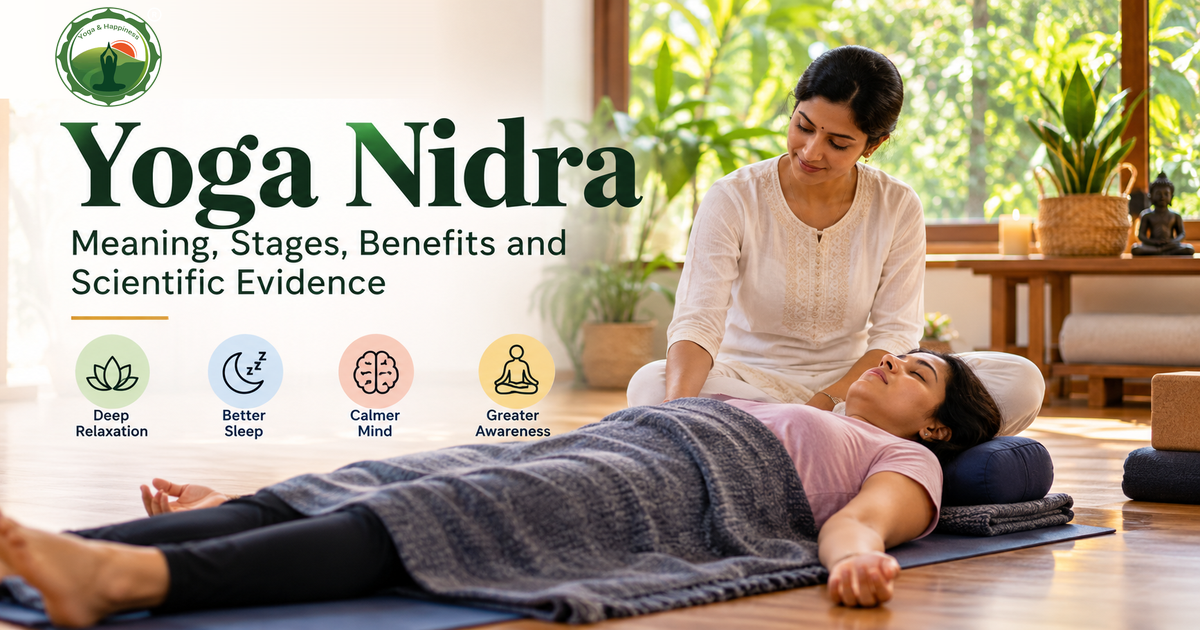
The practice is commonly performed in Shavasana, but comfortable seated or supported positions can also be appropriate.
Yoga Nidra is often discussed in relation to Pratyahara, the fifth limb of Ashtanga Yoga described in Patanjali’s Yoga Sutras.
Pratyahara concerns the relationship between the senses and the mind.
In Yoga Nidra, attention is guided away from constant engagement with external distractions and toward internal experiences.
This provides a useful philosophical connection, although Yoga Nidra as taught today should not be presented as a complete or identical expression of Patanjali’s Pratyahara.
The practice also introduces concepts relevant to Dharana, or concentration, because participants repeatedly return attention to a chosen object of awareness.
For yoga teacher training students, understanding these distinctions is important.
Traditional concepts explain the philosophical intention of the practice. Scientific research investigates measurable outcomes such as perceived stress, sleep quality and psychological well-being.
These are related but different forms of knowledge.
A frequently taught modern Yoga Nidra sequence includes eight stages. The precise order and terminology can vary between teaching traditions.
The practitioner settles into a comfortable resting position.
The instructor encourages physical comfort, minimal unnecessary movement and gentle awareness of the surrounding environment.
A blanket, cushion or support beneath the knees may improve comfort.
Sankalpa is a short personal intention or resolution.
Traditionally, it is expressed clearly and positively.
For example, a practitioner might choose an intention related to patience, steadiness or mindful living.
Sankalpa is a traditional component of some Yoga Nidra methods. Claims that it directly rewires the brain or guarantees behavioural change require stronger scientific evidence.
The instructor guides awareness systematically through different parts of the body.
Participants may be invited to notice the hands, arms, face, torso and legs without physically moving them.
This process is commonly called body scanning.
Its practical purpose is to support attention and awareness rather than to force the body into relaxation.
Attention shifts toward natural breathing.
Practitioners observe the movement and rhythm of the breath without deliberately controlling it.
Some methods include counting breaths.
Breathing should remain comfortable. There is no need to hold the breath or force a particular rhythm.
Certain traditional sequences introduce contrasting experiences, such as heaviness and lightness or warmth and coolness.
These are guided experiences of attention and imagination.
They should not be described as clinically proven trauma-desensitization techniques.
Participants should be free to skip sensations or imagery that cause discomfort.
The instructor may introduce simple images, natural landscapes or other familiar symbols.
Visualization can be adapted to the participant’s preferences and cultural background.
People who find imagery uncomfortable may instead remain attentive to breathing or physical contact with the floor.
In methods that include Sankalpa, the personal resolution may be repeated near the end of the session.
The intention is to reinforce conscious reflection.
Its psychological effects should not be overstated.
The session concludes with a gradual return to awareness of the surrounding environment.
Participants may notice sounds, move their fingers and toes, and slowly open their eyes.
Allowing time to reorient is especially important after a long relaxation session.
Research on Yoga Nidra has expanded, particularly in relation to sleep disturbances and psychological well-being.
However, the evidence remains limited.
A systematic review by Dutta and colleagues, published online in October 2025 and appearing in the March 2026 issue of the Journal of Integrative and Complementary Medicine, examined six randomized controlled trials involving 244 participants.
The studies included people with different sleep-related concerns and used different Yoga Nidra programmes.
Several trials reported improvements in sleep measures, including sleep onset and sleep efficiency.
However, the reviewers identified substantial methodological limitations, including variation between interventions, moderate-to-high risk of bias in many studies and inadequate reporting of adverse events.
The researchers concluded that Yoga Nidra is promising but requires stronger clinical trials before firm treatment recommendations can be made. PubMed
A separate systematic review and meta-analysis by Singh and colleagues, published on 27 April 2026 in Sleep and Breathing, examined Yoga Nidra for sleep disturbances and insomnia.
The quantitative analyses covered five unique studies.
Two randomized trials involving 181 participants contributed to an analysis of Pittsburgh Sleep Quality Index outcomes. The pooled result was not statistically significant.
Another analysis of insomnia severity, based on two randomized trials involving 99 participants, also did not reach statistical significance.
The authors rated the overall certainty of evidence as very low, citing small samples, risk of bias and differences between studies. PubMed
This distinction matters.
An individual study may report improvement, but a pooled analysis can still be too uncertain to establish a reliable treatment effect.
Current evidence suggests potential benefits for sleep, but it does not establish Yoga Nidra as a proven treatment for insomnia.
Many practitioners report feeling calmer after guided relaxation.
This is a reasonable experiential outcome to discuss.
Research on yoga more broadly suggests possible benefits for stress management and psychological well-being. However, findings from general yoga interventions cannot automatically be attributed to Yoga Nidra alone.
The National Center for Complementary and Integrative Health advises interpreting yoga’s health benefits in the context of the available evidence and individual safety considerations.
Yoga Nidra may therefore be introduced as an optional relaxation practice rather than a guaranteed intervention for anxiety, depression or trauma-related conditions.
No.
People experiencing persistent insomnia should seek appropriate medical assessment.
The American College of Physicians recommends cognitive behavioural therapy for insomnia, commonly called CBT-I, as the initial treatment for adults with chronic insomnia disorder.
CBT-I includes structured behavioural and psychological approaches specifically developed to address insomnia.
Yoga Nidra may be used as a complementary relaxation activity when appropriate, but it should not replace recommended treatment or prescribed medication. DOI
The following is an introductory relaxation sequence, not a standardized clinical treatment protocol.
Minutes 1–2: Preparation
Choose a quiet location and settle into a comfortable position.
Use cushions or a blanket if needed.
You may close your eyes or keep them softly open.
Minutes 3–6: Body Awareness
Gradually notice different parts of the body.
Begin with the hands and arms, then move toward the face, torso and legs.
There is no need to create any particular sensation.
Minutes 7–9: Natural Breathing
Observe the breath as it moves naturally.
Avoid forcing inhalation, exhalation or breath retention.
Minutes 10–12: Gentle Visualization
If comfortable, imagine a peaceful and familiar environment.
Alternatively, continue observing the breath or contact with the floor.
Minutes 13–14: Quiet Awareness
Rest without trying to achieve a special state of consciousness.
If thoughts arise, simply return attention to the instructor’s guidance or another comfortable point of awareness.
Minute 15: Gradual Return
Notice the surrounding environment.
Move gently and sit up when ready.
Avoid rushing into standing immediately.
Yoga Nidra is generally a low-intensity practice, but individual responses vary.
Extended stillness, internal attention or guided imagery may be uncomfortable for some participants, particularly those with certain trauma-related symptoms or dissociative experiences.
Instructors should offer choice rather than insist that everyone close their eyes, remain motionless or complete every visualization.
Participants should be encouraged to stop or modify the practice if they feel distressed, dizzy or uncomfortable.
Anyone receiving treatment for a significant psychological or neurological condition should discuss unfamiliar practices with an appropriately qualified healthcare professional.
Yoga instructors should not attempt to diagnose or independently treat mental health conditions.
Teaching Yoga Nidra requires more than reading a relaxation script.
A competent instructor should understand the traditional sequence, appropriate pacing, communication skills and the importance of participant consent.
Yoga teacher training should also include practical considerations such as positioning, accessibility, individual modifications and professional boundaries.
At more advanced levels, students should learn to evaluate research and distinguish personal experiences from scientifically established outcomes.
For example, reporting that a participant felt relaxed after a session is different from claiming that the practice treated a diagnosed sleep disorder.
Both traditional understanding and research literacy contribute to responsible instruction.
No. Yoga Nidra generally involves guided awareness during physical rest. Some participants may become drowsy or fall asleep, but ordinary sleep is not necessarily the intended experience.
Some studies report promising results. However, systematic reviews published in 2025 and 2026 identify important limitations, and the certainty of evidence remains low or very low.
A brief session of approximately 10–20 minutes may be a manageable introduction. There is no universally established optimal duration for every participant.
No. Sankalpa is an important feature of certain traditional Yoga Nidra methods, but participants should be able to choose whether to use a personal resolution.
No reliable evidence establishes Yoga Nidra as a cure for these conditions. It may be a complementary relaxation practice, but clinical assessment and appropriate treatment remain important.
Yoga Nidra offers an accessible way to explore guided relaxation, body awareness and meditative attention.
Its traditional methods remain valuable subjects of study for yoga practitioners and teachers.
Contemporary research suggests possible benefits for sleep and well-being, but the available evidence does not justify claims of guaranteed healing or disease treatment.
A responsible approach combines traditional knowledge, careful instruction, individual choice and accurate interpretation of scientific research.
Interested in learning traditional yoga practices and professional teaching methods?
Explore the Yoga & Happiness Certification Courses or contact Yoga & Happiness for information about available training programmes.
Dutta A, Mooventhan A, Nivethitha L, Dharani E. Efficacy of Yoga Nidra in Managing Sleep Disorders: A Systematic Review of Randomized Controlled Trials. Journal of Integrative and Complementary Medicine. 2026;32(3):235–241. DOI: 10.1177/27683605251390728.
Singh S, Dhanlika, Singh U, Haldar P, Sharma G. Effect of yoga Nidra (yogic sleep) in sleep disturbances and insomnia: systematic review and metanalysis. Sleep and Breathing. Published online 27 April 2026. DOI: 10.1007/s11325-026-03685-0.
Qaseem A, Kansagara D, Forciea MA, Cooke M, Denberg TD. Management of Chronic Insomnia Disorder in Adults: A Clinical Practice Guideline From the American College of Physicians. Annals of Internal Medicine. 2016;165(2):125–133. DOI: 10.7326/M15-2175.
National Center for Complementary and Integrative Health. Yoga: Effectiveness and Safety.
Get more news from us by subscribe your email address.
[mailpoet_form id="2"]
All Rights Reserved Copyrights 2021 | Powered by onqanet technologies pvt ltd
