×
19 Oct 2026
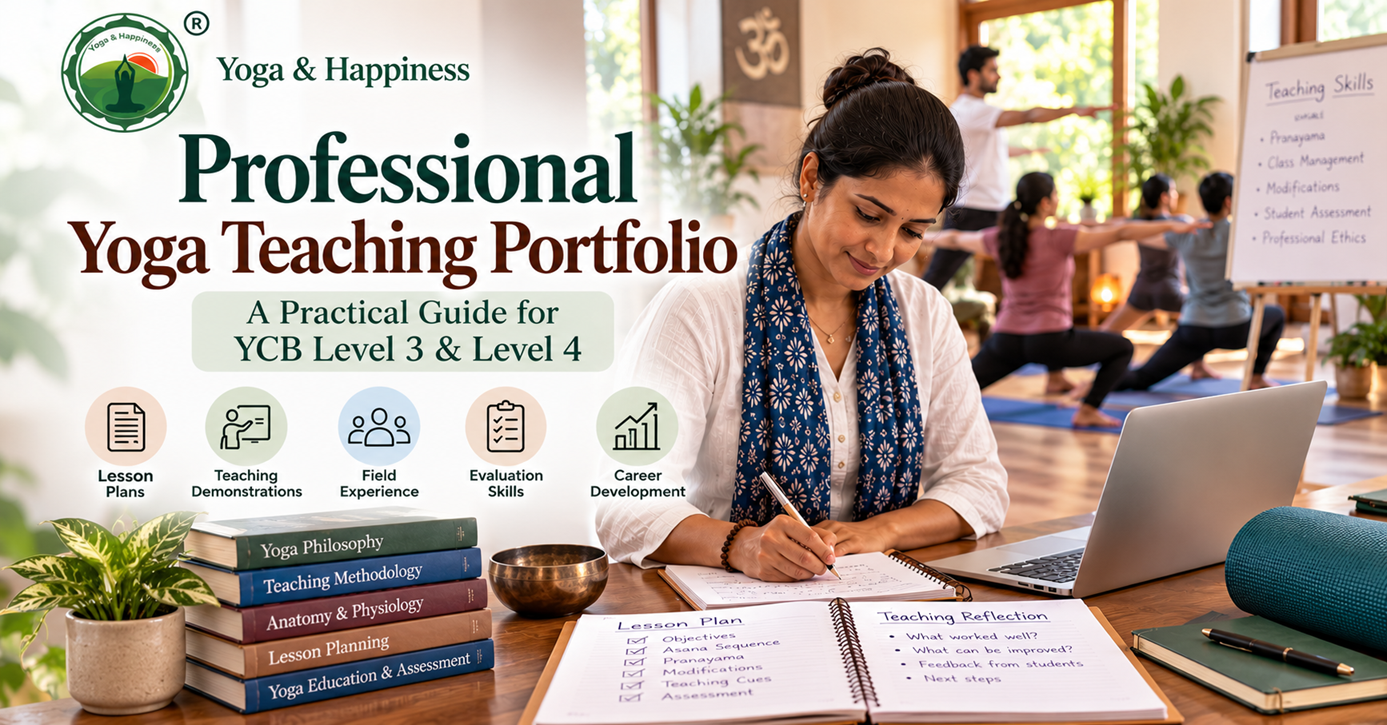
Completing advanced yoga training is an important step in developing a professional teaching career. However, a certificate alone does not demonstrate everything that a yoga teacher can do in a classroom.
Employers, training institutions and prospective students may also want to understand how an instructor plans lessons, communicates with participants, modifies practices, evaluates learning and maintains professional standards.
A yoga teaching portfolio helps organize this evidence.
For students preparing for YCB Level 3 Yoga Teacher & Evaluator or Level 4 Yoga Master, developing a portfolio can also encourage systematic teaching practice and reflection.
This guide explains what a useful portfolio should contain, how it relates to advanced yoga education and how to develop one without confusing professional documentation with official certification requirements.
A yoga teaching portfolio is a structured collection of documents and examples demonstrating an instructor’s qualifications, experience, teaching methods and professional development.
Unlike a conventional résumé, which summarizes education and employment, a portfolio provides practical evidence of teaching competence.
It might include lesson plans, teaching videos, class observations, training records and reflective reports.
The purpose is not to create an impressive-looking collection of certificates.
It is to demonstrate what the teacher knows, what the teacher can do and how the teacher continues to improve.
A strong portfolio should be accurate, concise and regularly updated.
YCB Level 3 is officially titled Yoga Teacher and Evaluator.
Its published syllabus includes teaching methods, lesson planning, classroom communication, evaluation techniques and field experience.
The practical assessment allocates marks to demonstration, teaching, evaluation, application of knowledge and field experience. Yoga Certification Board
These competencies provide a useful foundation for organizing a professional portfolio.
For example, a lesson plan can demonstrate instructional preparation, while a recorded teaching session can help the trainee review communication and classroom management.
A structured observation report can demonstrate an understanding of assessment principles.
The portfolio itself should be regarded as supplementary learning evidence unless the relevant examining authority specifically requires particular documentation.
YCB Level 4, Yoga Master, is intended for professionals developing advanced competence in yoga education, training and evaluation.
Its syllabus includes teaching methods, lesson-plan models, assessment principles, programme evaluation and administrative or mentoring skills.
The published syllabus also identifies field experience as a practical assessment component. Yoga Certification Board
Accordingly, a Level 4 portfolio should demonstrate more than the ability to conduct an individual yoga session.
It can document experience designing courses, mentoring instructors, observing teaching performance and evaluating educational programmes.
The progression is from competent teaching toward educational leadership.
Begin with a concise professional introduction.
Explain your educational background, yoga qualifications, teaching experience and areas of competence.
Include accurate copies of relevant certificates and clearly identify their issuing organizations.
Distinguish between completion of an institute’s training programme and successful certification by an independent examining body.
For example, completing a preparatory course does not automatically mean the candidate has passed the YCB certification examination.
Avoid using titles or professional designations that have not been awarded.
A teaching philosophy explains the principles guiding your instruction.
For a yoga professional, this might include respect for traditional yoga teachings, participant safety, appropriate progression and the importance of individual differences.
A useful teaching philosophy is specific rather than promotional.
Instead of writing, “My classes transform everyone’s life,” explain how you adapt instruction to different learning needs.
You might describe how you balance traditional practices with contemporary knowledge of anatomy, exercise safety and educational methods.
Advanced teachers should also explain how they distinguish yoga instruction from medical diagnosis and treatment.
Lesson planning is particularly relevant to the official Level 3 and Level 4 teaching-methodology syllabuses.
A lesson plan should identify the intended learners, learning objectives, practice sequence, instructional methods, modifications and assessment approach.
Consider a hypothetical 45-minute beginner class.
| Section | Duration | Teaching objective |
|---|---|---|
| Introduction and readiness check | 5 minutes | Establish goals and identify immediate concerns |
| Gentle preparatory movements | 10 minutes | Develop comfortable movement awareness |
| Selected beginner asanas | 15 minutes | Practise basic techniques with modifications |
| Breath awareness | 5 minutes | Observe natural breathing without strain |
| Guided relaxation | 5 minutes | Introduce comfortable relaxation |
| Questions and feedback | 5 minutes | Review understanding and learning needs |
This is an illustrative educational plan, not an official YCB examination sequence.
A strong portfolio should include several lesson plans for different teaching contexts.
For example, individual instruction, small-group teaching and online instruction require different approaches to communication and supervision.
A video can help demonstrate how an instructor communicates, demonstrates techniques and manages a session.
It should show more than advanced physical ability.
A useful teaching demonstration includes clear verbal instructions, appropriate pacing, participant observation and safe modifications.
A teacher who can perform a difficult asana is not necessarily able to teach that asana effectively.
Recordings should be used only with appropriate permission from everyone identifiable in the footage.
For public portfolios, a demonstration with a consenting adult volunteer or a simulated teaching session may be more appropriate than sharing recordings of paying clients.
Avoid displaying participants’ medical histories or other confidential information.
Practical experience is an important part of advanced yoga education.
The official YCB Level 3 syllabus includes field experience in the practical assessment, while the Level 4 syllabus also includes field experience and specific documentation provisions. Yoga Certification Board
A professional field-experience record can document the date, location, class format, duration, number of participants and the instructor’s responsibilities.
It can also include the teaching objective, general observations and a short reflection on the session.
Where photographs or attendance records are used, appropriate consent and privacy safeguards are essential.
Candidates must follow the documentation requirements communicated by their examination body rather than assume that a personal portfolio automatically satisfies official field-experience requirements.
Advanced yoga teachers should develop the ability to observe instruction systematically.
A useful observation form can examine lesson organization, communication, demonstration, modifications, time management and learner engagement.
For example, a peer observer might note whether the instructor explained a posture clearly, provided a suitable alternative and allowed enough time for questions.
Feedback should identify specific behaviours rather than simply label the teacher as good or bad.
The objective is professional improvement.
At Level 4, observation can extend to mentoring junior instructors and reviewing how consistently a training programme meets its stated learning objectives.
A portfolio becomes more valuable when it documents improvement over time.
After teaching a class, the instructor can briefly record what worked, what was difficult and what should change.
For example:
“Participants understood the standing posture demonstration, but several needed additional time to transition safely. In the next class, I will slow the sequence and demonstrate a chair-supported alternative.”
This is more useful than writing only that the class was successful.
Continuing education records may include workshops, supervised training, academic study and relevant professional development.
Do not include certificates for activities that were not completed.
Self-evaluation is an important professional habit.
For internal development, teachers can use a simple observation rubric.
| Competency | Suggested internal weight |
|---|---|
| Lesson planning and organization | 20% |
| Communication and clarity | 20% |
| Demonstration and technical accuracy | 20% |
| Safety and appropriate modifications | 25% |
| Reflection and responsiveness to feedback | 15% |
This is a proposed professional-development rubric, not an official YCB marking scheme.
Teachers should review the feedback alongside a recorded lesson or supervised teaching observation.
A numerical score is less useful if the instructor does not understand what needs improvement.
Testimonials can provide information about a participant’s experience, but they must be genuine and used with permission.
Avoid publishing identifiable client details without consent.
Do not present testimonials as scientific evidence that yoga treats a particular disease.
For example, a client’s report of feeling more relaxed after class is a personal experience.
It does not establish that the instructor has clinically treated an anxiety disorder.
A professional portfolio should prioritize verifiable qualifications, teaching evidence and responsible communication over exaggerated success stories.
Both formats can be useful.
A digital portfolio is convenient for sharing selected materials with potential employers or training institutions.
A printed portfolio may be helpful during interviews, practical examinations or teaching observations.
The important consideration is organization.
A concise portfolio with relevant evidence is generally more useful than a large collection of unrelated photographs and certificates.
A simple digital folder containing a professional profile, credentials, lesson plans, selected teaching demonstrations and observation reports can be an effective starting point.
A portfolio can help communicate professional experience and teaching competence.
It may support applications for teaching roles, institutional collaborations, workshops or independent instruction.
However, it does not guarantee employment, appointment as an examiner or recognition by a particular organization.
Employers and examining bodies establish their own eligibility requirements.
Yoga teachers should therefore treat a portfolio as one part of professional preparation, alongside appropriate qualifications, experience and continuing education.
An eight-week development plan can make the process manageable.
During the first two weeks, organize your qualifications, professional profile and teaching philosophy.
In weeks three and four, prepare lesson plans and conduct supervised or peer-observed teaching sessions.
During weeks five and six, review teaching demonstrations, document relevant experience and collect constructive feedback.
In the final two weeks, evaluate your progress, revise weak areas and prepare a concise portfolio suitable for professional review.
The schedule is flexible. Quality of evidence matters more than completing the process quickly.
Yoga & Happiness offers advanced teacher-training programmes that include practical yoga education, teaching methodology and preparation for professional certification.
The institute’s 800-Hour Advanced Yoga Teacher Training Course includes preparation for YCB Level 3 Yoga Teacher & Evaluator and an associated IYA advanced certification pathway, subject to the applicable assessment requirements.
Students seeking further development can also explore the YCB Level 4 Yoga Master course.
Course participation and independent certification are distinct processes. Candidates should confirm the current syllabus, eligibility, training requirements, assessment procedures and batch schedule before enrolling.
A general personal portfolio should not be assumed to be compulsory. Candidates must follow the official assessment and field-experience documentation requirements applicable to their examination.
A résumé summarizes qualifications and experience. A portfolio provides supporting evidence such as lesson plans, teaching demonstrations, observation reports and professional reflections.
Yes. Beginners can start with training records, sample lesson plans and supervised teaching demonstrations. They should describe their experience accurately.
Only when relevant. Advanced postures do not automatically demonstrate teaching competence. Communication, safety, lesson planning and instructional judgement are equally important.
No. A portfolio is a professional-development resource. It does not replace the certification process administered through the Yoga Certification Board.
Yes, provided the information is accurate and you have permission to publish any identifiable images, videos or testimonials.
A professional yoga teaching portfolio should demonstrate competence rather than simply collect achievements.
For advanced yoga teachers, it provides a structured way to document lesson planning, teaching experience, evaluation skills and continuing professional development.
The process can also reveal areas that need improvement.
Whether preparing for YCB Level 3, pursuing Level 4 or developing a professional teaching career, maintaining reliable evidence of your work is a useful long-term practice.
Interested in advanced yoga teacher training?
Explore the Advanced Yoga Teacher Training Course and Yoga Master Programme, or contact the institute for current admission information.
Yoga Certification Board, Ministry of AYUSH. Level 3 Yoga Teacher and Evaluator Syllabus (PDF). Official syllabus covering teaching methods, evaluation skills, practical assessment and field experience.
Yoga Certification Board, Ministry of AYUSH. Level 4 Yoga Master Syllabus (PDF). Official syllabus covering advanced teaching, assessment, mentoring and field experience.
Yoga Certification Board. How to Apply for Professional Certification. Official guidance on certification pathways and application procedures.
Get more news from us by subscribe your email address.
[mailpoet_form id="2"]
All Rights Reserved Copyrights 2021 | Powered by onqanet technologies pvt ltd
