×
15 Jul 2025
Online yoga teacher training has made structured yoga education accessible to people who cannot attend residential courses. Students can now participate in live classes, study yoga philosophy, practise teaching and prepare for professional assessments while living in different parts of India.
However, not every online yoga course leads to the same qualification.
Some programmes award an institute-issued completion certificate. Others prepare candidates for examinations conducted through recognized certification bodies. A university course, a YCB professional certificate and a Yoga Alliance-related credential should not be treated as interchangeable.
This guide explains how to compare online yoga certification courses in India and choose an appropriate pathway in 2026.
Before comparing fees or schedules, identify the organization that will issue the final certificate.
The Yoga Certification Board operates under the Ministry of AYUSH, Government of India.
Its professional certification framework includes qualifications such as Yoga Protocol Instructor, Yoga Wellness Instructor, Yoga Teacher and Evaluator, and Yoga Master.
The Level 1 Yoga Protocol Instructor qualification focuses on foundational yoga knowledge, practical demonstration and teaching skills.
According to the official YCB syllabus, the Level 1 assessment comprises 60 theory marks and 140 practical marks.
Candidates must meet the applicable assessment requirements to obtain certification. Enrolling in a preparatory training programme does not automatically result in a YCB certificate.
Official syllabus: YCB Yoga Protocol Instructor.
The Indian Yoga Association offers its own educational, professional and institutional pathways.
Its Foundation Course in Yoga and other programmes should be evaluated according to their respective requirements.
An institute’s IYA Associate Centre status does not automatically establish direct YCB training-centre accreditation.
Students should confirm which certificate is included, who issues it and whether separate assessments or fees apply.
Some yoga schools and universities issue their own completion certificates, diplomas or academic qualifications.
These may be useful for personal education or professional development, but their recognition and eligibility for particular jobs depend on the awarding institution and the employer’s requirements.
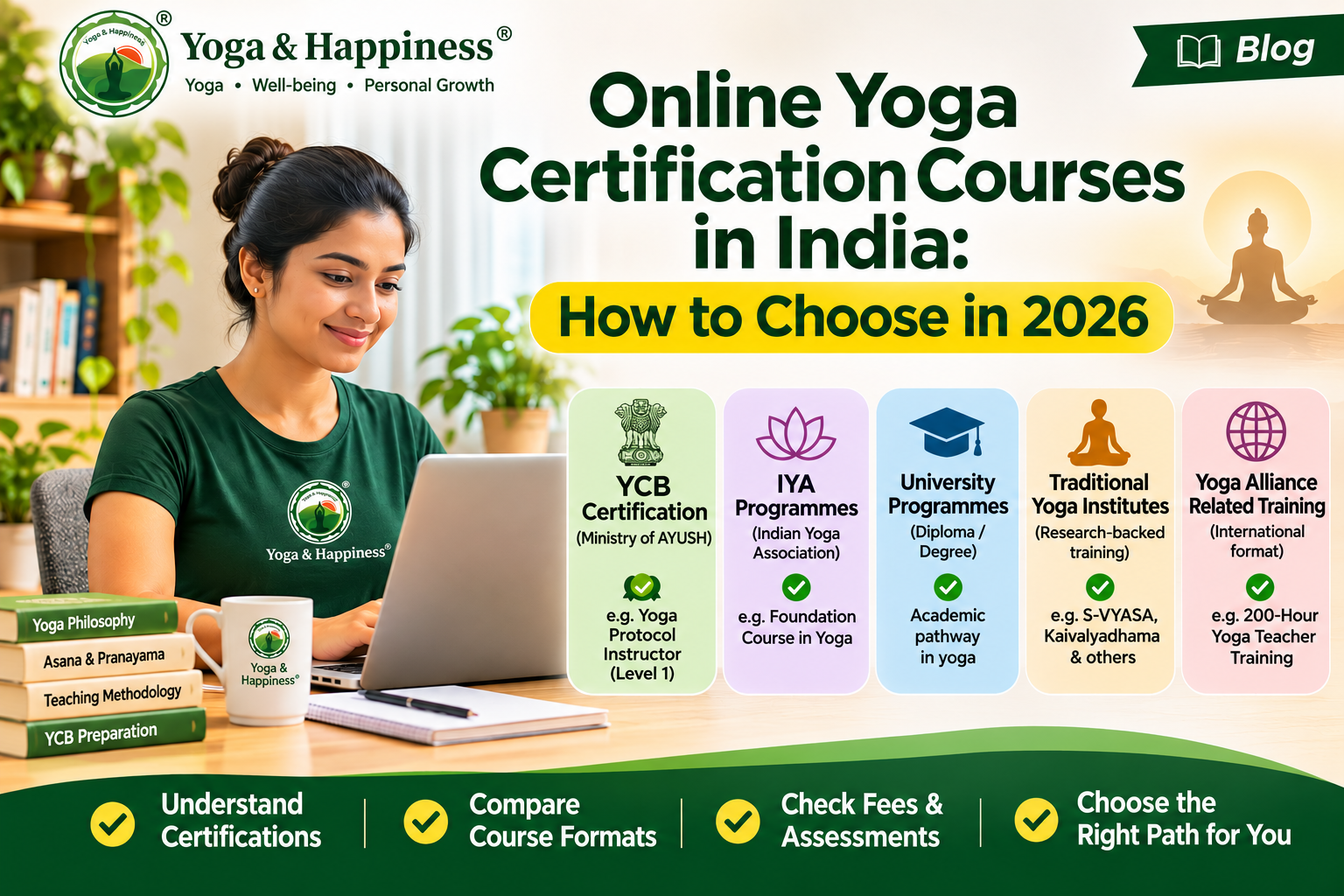
Rather than treating five institutions as a fixed ranking, compare the following educational pathways.
| Pathway | Suitable for | What to verify |
|---|---|---|
| YCB Level 1 preparation | Aspiring foundational yoga instructors | Authorized assessment route and exam fees |
| IYA Foundation Course | Beginners seeking structured traditional yoga education | Certificate issuer and course requirements |
| University yoga programmes | Students pursuing academic progression | University recognition, entry requirements and delivery mode |
| Traditional yoga institute courses | Learners emphasizing philosophy and practice | Course format and nature of the award |
| Yoga Alliance-related teacher training | Candidates exploring international studio opportunities | School registration, current online rules and destination-country requirements |
Institutions such as S-VYASA, Kaivalyadhama, Bihar School of Yoga and Sivananda Yoga Vedanta Centres are relevant research starting points. However, specific online programmes, prices, admissions and certification eligibility must be checked on their current official websites before making a comparison.
No particular institution should be described as the best without transparent, current comparative evidence.
Online yoga education generally uses three delivery formats.
Live interactive training allows instructors to observe participants, explain practices and respond to questions in real time.
Recorded training offers scheduling flexibility and opportunities to revisit theoretical explanations, but recorded demonstrations alone cannot establish practical teaching competence.
Blended training combines live teaching, recorded lessons, assignments and supervised practice.
For aspiring yoga instructors, the availability of feedback is especially important.
Ask how the institute assesses demonstration skills, breathing practices, lesson planning and teaching communication.
Also confirm whether recordings supplement live instruction or replace it.
A credible foundational course should develop knowledge and practical competence progressively.
Important subjects include yoga history and philosophy, introductory anatomy and physiology, foundational asanas, pranayama, meditation, teaching methodology and professional ethics.
The course should explain precautions and contraindications rather than encourage every student to attempt identical postures.
Practical teaching experience is also important.
Students should learn to give understandable instructions, observe participants and recognize situations requiring modification or referral.
The exact syllabus should correspond to the qualification being pursued.
A lower advertised fee does not necessarily mean a lower total cost.
Before enrolling, request written confirmation of the full amount payable.
Check whether the quoted price includes registration, examinations, certificates, study materials, recordings and any applicable taxes.
Also ask about re-examination charges, refund conditions and access to additional training if further preparation is required.
For example, Yoga & Happiness currently lists its Beginner Yoga Teacher Training Course at ₹15,000. Its published programme includes live online training, recordings and preparation for the YCB Level 1 examination. Prospective students should confirm the complete current package and assessment arrangements before payment.
Online learning can contribute to professional preparation when it includes suitable practical instruction and assessment.
However, obtaining a certificate is not the same as becoming an experienced teacher.
New instructors should continue supervised practice, develop communication skills and gain experience teaching beginners.
They should also understand the limitations of their qualification.
Foundational yoga teacher training does not independently qualify someone to diagnose medical conditions or prescribe individualized yoga therapy.
Employment opportunities may include community classes, yoga studios, online instruction and workplace wellness, subject to employer requirements and professional competence.
No course should promise guaranteed employment or unrestricted international eligibility.
A prospective student should be able to obtain clear answers to these questions:
Written answers help students compare programmes fairly.
Yoga & Happiness offers a 200-hour beginner yoga teacher training programme designed around the YCB Level 1 Yoga Protocol Instructor syllabus.
The programme includes live online instruction in foundational practices, yoga philosophy and teaching methodology.
Students can also receive guidance for examination preparation and mock assessments.
The YCB certificate is issued through the applicable authorized assessment process after the candidate meets the certification requirements.
Explore the Beginner Yoga Teacher Training Course for the published programme and fee.
Validity depends on the awarding organization, qualification and intended use. Verify the issuer and assessment route rather than relying only on the word certified.
No. Candidates must satisfy the applicable YCB assessment requirements.
A structured 200-hour programme can be an appropriate starting point when it provides foundational teaching, practical supervision and a suitable progression.
Requirements differ by country, employer and professional setting. No single certificate guarantees permission to work internationally.
No. They are separate credentials with different issuing organizations and requirements.
Choosing an online yoga certification course should begin with the qualification you want to earn, not the promotional claims of an institute.
Compare certificate issuers, assessment requirements, practical instruction, faculty expertise, total fees and professional opportunities.
A credible programme should help you become a knowledgeable and responsible yoga practitioner and teacher, while clearly explaining what its certificate does and does not authorize.
Get more news from us by subscribe your email address.
[mailpoet_form id="2"]
All Rights Reserved Copyrights 2021 | Powered by onqanet technologies pvt ltd
